
The question of how to vote on the proposed PSC contract is simpler than it may appear. At its core, this vote is a referendum on the two-tier system of labor at CUNY and universities across the country. A YES vote is a vote to continue the deepening of the two-tier system. A NO vote is a vote to reject this system and to chart a different path.
We are told there is a third option: to support this contract as it is, and fight to close the gap in the next one. As we have documented, this is the same line adjuncts have been fed by the New Caucus for over decade, an appeal to the eternal “next time,” which never ever comes. In 2007 President Bowen announced a “multi-contract strategy”, to be spread across three contracts. As usual, adjuncts were told they had to wait for pay parity, which was pushed to “Phase III”, the third of three contracts. Guess which contract that is? This one! And now… we’re being told to wait for the next next time?
Under the two-tier system, one increasingly shrinking proportion of the union (full time faculty) earn proportionately higher wages for the same work done by an increasingly growing contingent of the union (adjunct faculty). The former enjoys job security while the latter is consigned to precarity which worsens as wages fail to keep up with inflation, to say nothing of New York rents. But this is not simply a matter of full-timers winning and adjuncts losing. As the gap grows, and inequality increases, our power to collectively bargain weakens, and on a long enough time frame, we all lose.
And why is this gap growing? Because with each contract that offers flat, percentage-based increases in wages, as the current contract does, our “social justice” union enforces one of the main rules of capitalism: those who make more money… end up making more money. Ten percent of Paul Krugman’s disgusting $250k salary — to study income inequality! — is roughly what a full-time adjunct can expect to make teaching eight courses in a single year. And ten percent of the more modest $75,000/year is still a whole different story than ten percent of $2,900 per class, and next time around, ten percent of that will only worsen the divide. To compound this, the PSC engages in “pattern bargaining” — accepting similar flat-rate raises as unions like DC 37, none of whose employees are paid the sub-minimum wage rates of an adjunct professor. The result of this practice, which has no place in a union with a majority of adjuncts, is a disaster for the most vulnerable members of the PSC, for whom pattern bargaining ensures wages will continue to lag further behind those of full-time faculty with every contract.
For years the PSC leadership has paid lip service to closing the gap. But in every new contract the PSC has refused to put its money where its mouth is. Even if we are to assume that there is a finite amount of money to be distributed across CUNY — a contention that CUNY Struggle firmly rejects, as history teaches us this sum is determined by our level of struggle, not a set budget — any contract deserving of a YES vote will have to distribute more equitably the available funds, signaling a strong commitment to raising up the most exploited members of the union. Even if this is the most money we can get, the only contract deserving of a yes vote will disproportionately prioritize those among us living in poverty, and establish our bargaining unit as a cohesive bloc capable of acting in solidarity, instead of a tale of two cities, which is what it is now.
This is not a moral argument, though there is of course a great moral wrong about the income inequality at CUNY, with which far too many “progressive” and “radical” faculty seem all too comfortable. At root, however, this is a question of our collective power as workers. The old slogan “an injury to one is an injury to all” is not a moral imperative that cuts against individual self interest. It is a practical reality of how class struggles are fought and won. Attacks on the lowest paid members of any union serve to devalue the labor of the entire union and to degrade the value of labor power and working conditions over time. In the tragic history of US unionism, management across industries has relied on the highest paid workers to take deals which appeal to short-term gratification, at the expense of their low paid colleagues, and more importantly, to the detriment of long term working class power in the entire industry. What’s true in the UAW is true in the PSC.
To those who question the strategy of the NO campaign, we ask: Why did it take six years to get a contract? Why did it take five years to organize a direct action campaign? Where was the grassroots support on the campuses? For decades adjuncts have been organizing to advance their demands, gathering petitions, speaking out at the Delegate Assembly, patiently explaining their plight to PSC leadership and full-timers, only to have their plight fall on deaf ears, time and again. In the interest of not fighting the two-tier system, adjuncts are consistently demobilized, their grievances silenced, their activism ignored, their demands placated with empty promises, and after decades of undercutting their potential as a militant force in the union, the bureaucrats scratch their heads and wonder why it’s so hard to energize the rank and file! It doesn’t have to be this way.
The YES camp is rebuking us for lack of strategy, because the only real message of their failed strategy is “there is no alternative” — and we are that alternative. Our strategy is very simple: we are the movement that stands up against the two-tier system, here and now. Instead of ignoring adjunct demands and deferring them to the eternal “next time”, we embrace and build on a grassroots basis the power of contingent labor that is being squandered daily by PSC leadership and their bankrupt strategy. By coordinating a NO vote and forcing onto the table a new contract that mitigates the two-tier system, rather than strengthens it, we are initiating a rebellion from below against an indefensible status quo, and making a necessary intervention in a union that has grown far too complacent in gradually managing its own demise. We are the movement that will rejuvenate worker power at CUNY, not by repressing the needs and the organizing efforts of a majority of the union, but by incorporating this powerful social force into a grassroots movement of CUNY workers and students for economic justice.
How many more labor scholars, or self-identified labor movement veterans, or social movement experts, and so forth, do we need to have in our union before the indefensibility of the two-tier system is widely recognized in practice, rather than just in a bunch of righteous words? How much longer will we allow the two-tier management tactic to persist unchallenged at CUNY, weakening our ability to fight with every passing contract, while it devastates the lives of our most exploited colleagues? When are we going to take a stand and VOTE NO ON THE TWO-TIER SYSTEM? Now? Or next time?
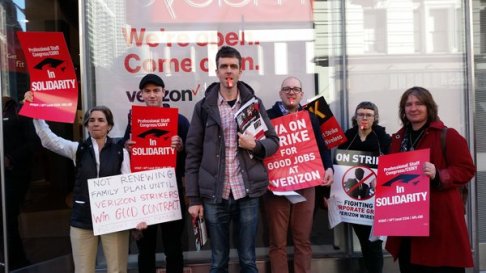 ets in solidarity with striking Verizon workers. We will be posted up at the Herald Square location (1293 Broadway) at 5:30pm on Mondays and Wednesdays until Verizon caves in and does right by its workers! We feel small gestures of solidarity like this are necessary not only to build our capacities within the CUNY system, but to build and strengthen ties of practical solidarity with the broader NYC working class.
  If the latter, no one knows what the magic number is that will cause Barbara Bowen & Co. to throw up their hands and resort to what in our view is the only tactic that can secure even the bread-and-butter goals of this ostensibly social-justice union—labor’s most powerful weapon, a strike. In the PSC press release and Bowen’s e-mail message to members, Bowen refers simply to a “decent economic offer” without providing specifics. The only thing we know for certain is that the union has rejected CUNY’s insulting
  ly in negotiation/mediation, they might refer to the following PSC records from 2004, 2007, and 2010.

 cunystruggle.org